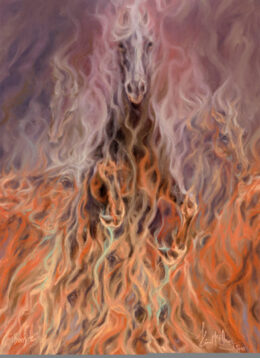
Happy New Year from Eponaquest Worldwide! This original painting by Kim McElroy, “Bonfire,” depicts the majesty of the fire horse, one of the archytypes featured in Way of the Horse. 2026 is the Year of the Fire Horse in Chinese astrology: time to clear the past, illuminate oppressive patterns, and burn through blocks to living life fully. In Linda Kohanov’s 2007 collaboration with Kim McElroy, Way of the Horse: Equine Archetypes for Self-Discovery (expanded and updated in 2022), the author explored the meaning of this ancient symbol, offering insight into how we can harness its awe-inspiring power. In honor of this auspicious year, Linda is not only offering the full essay on the Fire Horse below, she’s taking more than 50% off the Way of the Horse book and deck of cards (autographed by request). Learn how you can receive your own discounted copy of this critically acclaimed, interactive tool for bringing horse wisdom back to the human world at the end of this edition of Eponaquest News. You can also receive 50% off the online course where Linda teaches you how to use the deck for personal reflection.
But first: Here’s the entire unedited essay on what the Fire Horse represents, and how this archetype can inform your own choices in the coming year.
BONFIRE
Sudden Shift
Clearing and Releasing
Fuel for Transformation
A rearing fire horse demands attention, drawing power from his blazing herd.
THE GIFT
Whether by choice or circumstance, tremendous energy is available to burn through any blocks to a wider view.
THE CHALLENGE
It’s no small task to stay present during intense outbursts of power whether human, equine, or divinely inspired. Be ready to face areas of resistance that have grown into a volatile source of fuel for the fire.
THE JOURNEY
People are either elated or distressed by Kim McElroy’s fire horse imagery, reactions that at first surprised the artist, who was herself born during the year of the fire horse (1966). Then again, according to Chinese astrologers, she should have expected it. To be born a fire horse is thought to court either spectacular good luck or unmitigated disaster. In Asian cultures, where demure, subservient females are highly valued, women from the fire horse cycle of 1906 battled tremendous hardships. Considered embarrassingly adventurous, passionate, headstrong, even deadly to men, many were subjected to poverty and starvation. Though the stigma lessened in subsequent decades, some parents still avoided giving birth in 1966, and to this day a woman who identifies herself as a fire horse in casual conversation is said to be making a serious statement.
Hot-blooded horses inspire equally prejudicial reactions in riders who value placid mounts. I’ve met a number of equestrians who malign the Arabian, a proud and spirited desert breed, with the same venom usually reserved for denouncing traitors, drug dealers, and terrorists. Fire, in any form it takes, quite simply inflames and terrifies people because it challenges the very idea of human superiority. Even the tiniest smoldering cigarette butt demands humility and awareness. In a moment of carelessness, you can set the backyard on fire, burn down half the neighborhood, or take out an entire forest.
When we moved our horse operation to a historic ranch in Sonoita, Arizona, we were delighted by the majestic cottonwoods, sycamores, mesquites, and live oaks winding languidly along stream-lined canyons and vast stretches of high-desert grasslands. But paradise in the rainy season was sheer stress during drought. The staff spent weeks cutting down acres of grass so dry it had turned red, watering trees that were losing leaves in early summer, and, most important, pruning much of the deadwood that had accumulated from years of unchecked growth.
This, of course, is the key to managing both the literal and metaphoric dangers of fire: the more fuel you have lying around, the more intense and out of control the blaze becomes when it finally hits. And it will hit someday, intentionally or accidentally, in any number of ways: an absentminded camper, a vengeful arsonist, an errant lightning strike, a drunken backyard barbecue. Denial of fire’s potential to change your life – dramatically and irrevocably – is not an effective strategy. Better to befriend, respectfully, its ability to swiftly challenge your assumptions, clear what is no longer useful, and open you up to a wider view.
This is no small task for the comfort oriented. Consequently, we’re often dragged, kicking and screaming, out of our complacency through some desperate situation, enhancing fire’s ruthless reputation. The thirteenth-century Sufi poet and mystic Rumi realized that sudden transformation feels as devastating to the ego as any towering inferno of “real” smoke and flame. He spent much of his life – and art – summoning the courage to face it: “Desperation, let me always know / How to welcome you / And put in your hands the torch / To burn down the house.”
In The Way of Passion: A Celebration of Rumi, Andrew Harvey observed that we often “smother that desperation, we coddle it, we comatize it. The world is in terrible denial of what is actually going on, because people are simply afraid of the level of desperation that they would feel if they faced what is going on.” Rumi encourages us to “follow that desperation right to its home which is in Divine initiation, Divine transformation.” He asks “desperation to ‘take a torch and burn down’ all our concepts, limits, fantasies, and banal solutions.”

Luckily, we don’t have to wait for lightning to strike. It’s also possible to do our own internal clearing, our own controlled burns, and a number of contemplative traditions have developed procedures for just that. While dabblers in mindfulness techniques often presume transcendence is the goal, this often leads to what the psychologist John Welwood calls “spiritual bypassing,” using religious or meditative practices to evade the very challenges and mysteries we’re called to experience on earth. Those who seriously study these traditions agree that the most efficient route to heaven does not skirt around or float above the difficulties of embodied existence, it burns right through them.
Reggie Ray, a professor of Buddhist studies at Naropa University, actually considers disembodiment a “modern crisis,” a misuse and misunderstanding of the path to enlightenment. “Until we are willing to live through some of the wealth of information and emotions that have been offered to us but rejected, our awareness remains tied up and restricted,” he emphasized in his 2006 Tricycle article “Touching Enlightenment.” The “experience of working with the body unlocks memories and images and emotions that become fuel. This fuel creates a fire in us, a fire of all the vivid and intense pain held by these previously rejected aspects of experience. That pain is a fire that gradually burns up the structure of the ego – it is a visceral inferno. According to the early tradition, enlightenment itself is when the fuel is all used up. Awareness, no longer tied up in evasionary tactics, is set free and liberated to its full extent.”
The opposite of evading experience is deceptively simple: staying fully present to whatever happens. In other words, before you decide what should or shouldn’t happen, what you or your horse should or shouldn’t feel, notice what is happening, what you are feeling. It helps to imagine breathing into the sensation, sending it oxygen and awareness.
Becoming aware of an experience, exactly the way it presents itself, is like lighting a match and efficiently burning through what would otherwise become an unconscious block. The warmth and light of this smaller, more manageable fire can even help illuminate creative solutions.
The ego, or conditioned personality, can’t see the forest for the trees. Even worse, aspects of life it continually evades and denies accumulate like dried twigs and branches. Over time, this False Self panics when encountering authentic feelings and experiences, knowing instinctually that present circumstances, fueled by the debris of the past, are supercharged to ignite a colossal blaze.
When the Buddhist master Chogyam Rinpoche was asked, “How do you exhaust karma?” he said: “When things come up in your life, you feel them completely and fully and you don’t hold back. You live them right through until they have completed themselves.” Feeling an experience completely doesn’t mean melodramatically acting out the emotions or taking them out on others to relieve the pressure. It means letting an experience move you to the core rather than dissociating from it, perhaps leaving you raw and vulnerable for a time, yet ultimately strengthening your ability to embrace life fully and consciously, inspiring others in the process. This goes for “positive” as well as “negative” feelings.
The ego knows that intensely ecstatic experiences are just as likely to burn out of control, and so it struggles to keep everything at a nice, safe, even keel. “When we are blissful and happy, we go along to a certain point but then pull back,” Ray observes, “because we are afraid – perhaps it is too much and we feel we are losing our sense of self, or perhaps we are afraid it will slip away. This is because true bliss and happiness, perhaps more so than pain, are the negation of the human ego.”
“Light the incense!” Rumi advises. “You have to burn to be fragrant, to scent the whole house, you have to burn to the ground.” Burning the ego to the ground in a sometimes terrifying, yet ultimately ecstatic, bonfire is a cross-cultural theme. The Bible abounds with images of the cleansing and creative properties of fire, as do Greek myths and accounts of medieval alchemists who were obsessed with turning the lead of earthly experience into soul’s gold.
Various wisdom traditions also agree that most richly scented “incense” is gleaned from significant, deeply felt pleasure and pain. I’m not talking about sadomasochism, which seeks to vaguely approximate and, most important, control these fires, often through fantasy; nor am I referring to drama queens and adrenaline junkies addicted to manufacturing intense experiences. The same person who spurs the bucks out of a horse for sport or engages in fiery romantic relationships may shut down emotionally – or literally run screaming in the other direction – when a loved one becomes ill or a sexual attraction shows potential for true intimacy. Living life fully, feeling it completely, provides enough excitement, enough fire to inspire, entertain, and enlighten.
The fire horse archetype itself provides clues to a more balanced way of approaching life’s volatility. These nonpredatory, nomadic, relationshiporiented creatures don’t try to control the environment or argue with fate; they experience each moment openly and authentically – and then “go back to grazing.” By this definition, every horse is a fire horse at times, blazing through moments of fear, power, pain, excitement, loss, playfulness, and unmitigated joy.
Perhaps more important, horses spend a significant portion of each day milling languidly about in a state of deep peace: that bliss of pure being arising naturally when there’s nothing left to burn.
Copyright 2007 by Linda Kohanov
Way of the Horse Discount
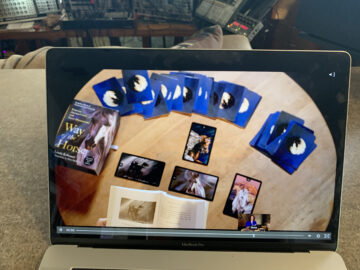
The Fire Horse is a Chinese symbol that will be fully activated on the Chinese New Year February 17, 2026. Between now and this date, you can receive Way of the Horse: Equine Archetypes for Self-Discovery at a special price of $17 (more than 50% off) at this link:
https://steveroach.bandcamp.com/merch/way-of-the-horse-book-oracle-deck-by-linda-kohanov
Please note that shipping costs vary internationally for this beautifully packaged book and horse wisdom card deck. (In the US shipping is $6, in Canada: $27, and the rest of the world: $35).
You can also receive 50% off the online course where Linda teaches you how to use the deck, offering sample card readings, as well as a history of how the deck was created. Just use the coupon code 50horse at https://lindakohanov.com/ (Scroll down the courses on the home page and click on the enroll now button under the Way of the Horse entry).
Special Workshop Offer
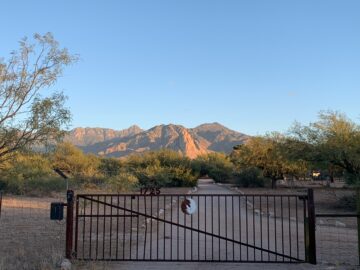
For those of you interested in attending a workshop with Linda and the Eponaquest herd, you can receive a free copy of the book when you register for an upcoming event between now and February 17. (No need to go to the sales link. You will automatically receive the book when you register for the workshop. We can mail it to you at no additional cost, or you can pick it up when you arrive in person at the event of your choice.) Linda’s stunning desert facility in Amado, Arizona is the setting for these in-person, equine-facilitated events (scenic lodging options nearby). Over the last year, the author and founder of Eponaquest Worldwide has been cutting back on seminars due to a number of private contracts that are bringing her work to larger corporate and social service organizations. Here are links to upcoming workshops open to the public:
- The Tao of Equus 2026: Mindful, Authentic, Heart-Centered Wisdom for Personal Well Being and Professional Success — February 14, 2026 – February 17, 2026
- Beyond Words: The Art and Science of Sentient Communication — February 27, 2026 – March 2, 2026
- The Crossroads of Wisdom: Navigating the Mystery and Practicality of the Second Half — April 17, 2026 – April 20, 2026